Controlled substances are part of daily practice in veterinary medicine, and the recordkeeping around them is one of the areas most likely to surface in a compliance review. The federal framework is detailed but knowable. This guide separates what the Code of Federal Regulations (CFR) actually requires from what is widely recommended as best practice — and shows where a tool like Accedo fits, which is in keeping a dated, exportable record that every staff member acknowledged the procedures you set.
DEA Form 222 and the ordering process
DEA Form 222 is the official paper order form used to order Schedule I and Schedule II controlled substances. It is signed and dated by the DEA registrant (or a person holding a valid power of attorney). The Controlled Substances Ordering System, or CSOS, is an optional electronic alternative to the paper form — it is not mandatory, and a practice may continue to use paper Form 222 if it prefers (21 CFR Part 1305).
A veterinarian who handles controlled substances registers with the DEA, and that registration is renewed every three years. The registration, the ordering records, and the dispensing logs together make up the paper trail an inspector expects to find in order.
Inventory and retention rules
The CFR sets out clear, checkable obligations for controlled-substance records:
- A biennial inventory — an inventory of controlled substances on hand taken every two years (21 CFR 1304.11).
- Controlled-substance records are retained for at least two years (21 CFR 1304).
- Schedule II records are kept separately from Schedule III–V records.
- Transaction logs capture the substance, strength, and dosage form; the date; the amount dispensed, administered, or wasted; and the running balance — recorded immediately as each transaction happens.
These are the bright-line rules. They are about the substances and the paperwork, and they live in the controlled-substance log itself, not in a policy-acknowledgment tool.
Where written procedures and training come in
21 CFR 1301.71 requires registrants to provide effective controls and procedures to guard against theft and diversion. The regulation speaks in terms of security outcomes; it does not prescribe a signed standard-operating-procedure document. In practice, the way reputable practices satisfy that obligation — and the way they make it provable during an inspection — is to write down their controlled-substance procedures, train staff on them, and run periodic internal audits. That is best practice and audit-readiness, not a line item the CFR mandates as a signed SOP.
The risk that this best practice addresses is real. In a compliance-training course cited by AAHA and taught by a former DEA Supervisory Special Agent, the instructor attributes roughly 96% of controlled-substance compliance problems to recordkeeping and procedural failures rather than to deliberate diversion. We present that figure as it was framed by that instructor — an experienced practitioner's estimate offered in a training setting — not as an official statistic published by the DEA. The takeaway is the same either way: most exposure comes from process gaps that good documentation and trained staff prevent.
How Accedo fits
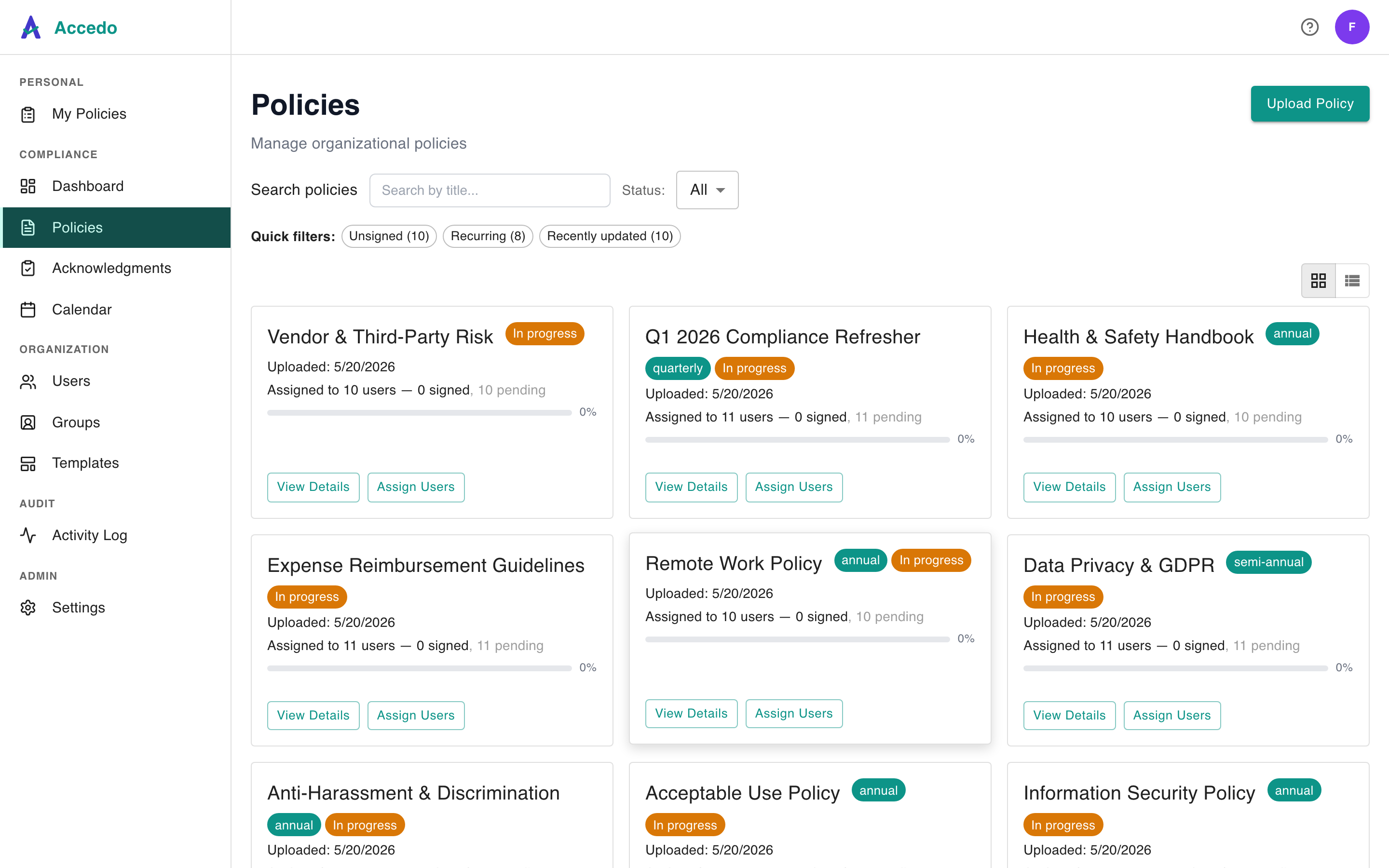
Accedo does not replace your controlled-substance log, your DEA Form 222 records, or your biennial inventory — those stay where they belong. What Accedo does is close the documentation gap around the procedures: it gives you a dated, signed record that every staff member read and acknowledged the controlled-substance procedures you wrote.
- Publish the procedure as a policy, and auto-assign it to the staff and groups who handle controlled substances.
- Collect a dated signature from every signer, so you can show exactly who acknowledged the procedure and when.
- Re-acknowledge on a recurring cadence — for example annually, so the team re-confirms the procedure after each update or on a fixed cycle.
- Export the audit trail — a timestamped record you can hand to an inspector or include in an internal audit.
That separation is the point. The CFR governs the substances and the logs; Accedo gives you provable evidence that your people were trained on, and acknowledged, the procedures that keep those logs accurate.